Private label clothing is one of the fastest-growing business models in the fashion industry. It allows entrepreneurs, retailers, and online brands to sell clothing under their own brand name without owning a factory — and without starting entirely from scratch. But many people entering the space do not fully understand what private label manufacturing actually means, how it differs from other business models, or what the realistic steps are to getting started.
This guide explains what private label clothing is, how it works in practice, and what you need to do to launch your own private label clothing brand — from choosing a manufacturer to building your first collection.
What Is Private Label Clothing?
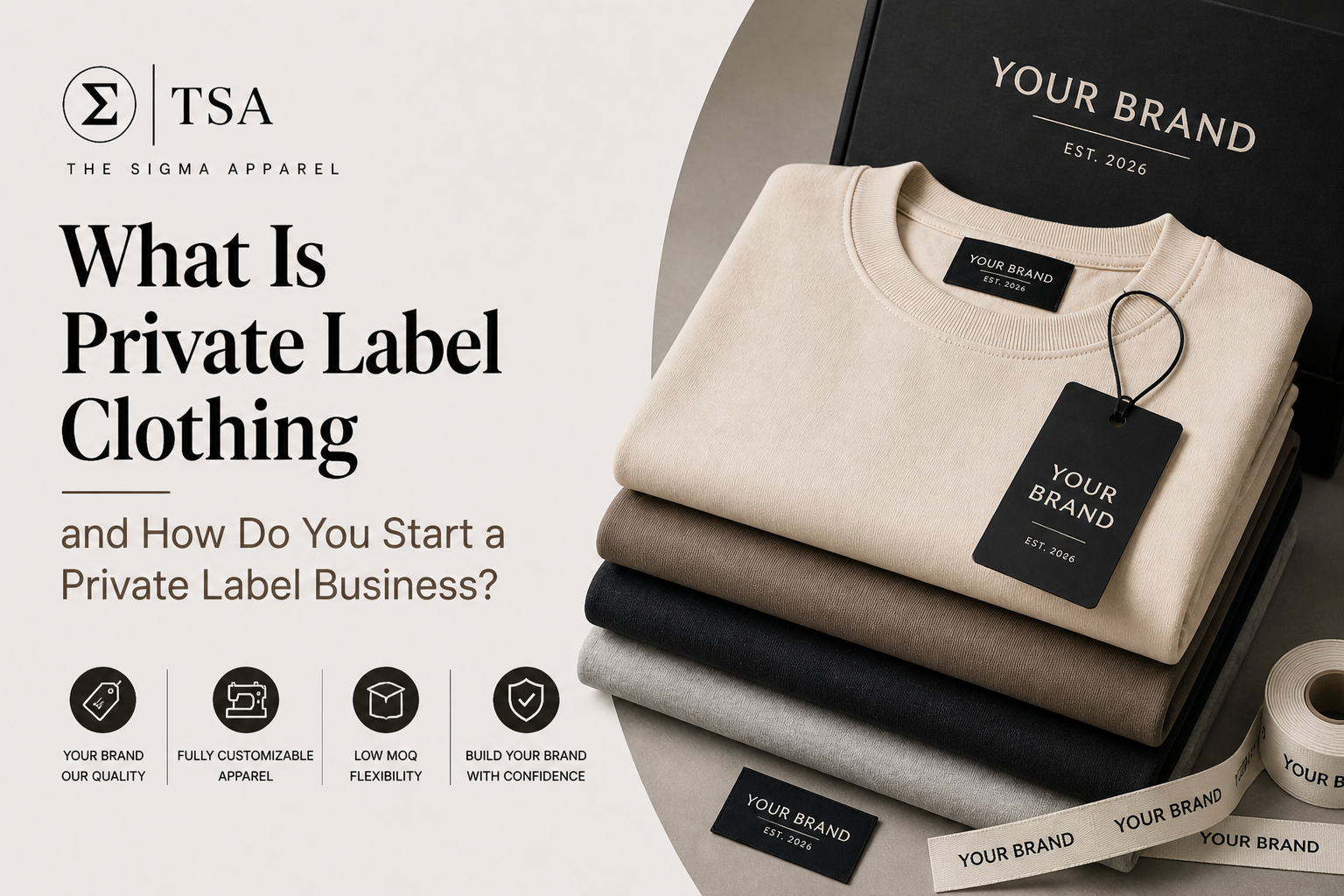
Private label clothing refers to garments that are manufactured by a third-party manufacturer and sold under your brand name and label. The manufacturer produces the garment; you own the brand. This is different from white label (where the same generic product is sold by multiple brands with different labels) and different from buying wholesale (where you resell another brand’s existing products). Our guide to wholesale vs private label clothing covers the key differences in detail.
With private label manufacturing, you have control over the design, fabric, construction, labelling, and packaging of your products — within the parameters of what your chosen manufacturer can produce. The garments are manufactured exclusively for your brand and cannot be sold by other businesses.
How Is Private Label Different from Cut and Sew?
Private label and cut and sew are related but not identical concepts. Cut and sew refers to the manufacturing method — building a garment from raw fabric using a custom pattern. Private label refers to the business model — selling manufactured goods under your own brand name.
You can do private label manufacturing using cut and sew (building garments entirely to your spec from scratch) or by customising existing garment constructions with your brand’s colours, labels, and finishing. Most serious private label brands use cut and sew manufacturing because it gives them a genuinely unique product that competitors cannot easily replicate.
What Products Can Be Made Under Private Label?
Almost any garment category can be manufactured under a private label arrangement. The most common private label clothing products include:
- T-shirts, hoodies, and sweatshirts — the foundation of most private label casualwear and streetwear brands
- Activewear and gym wear — leggings, sports bras, shorts, and performance tops
- Denim — private label jeans, jackets, and shorts
- Swimwear — bikinis, one-pieces, boardshorts, and cover-ups
- Lingerie and underwear — bras, briefs, bodysuits, and loungewear
- Workwear and uniforms — corporate shirts, safety apparel, and branded workwear
Sigma Apparel offers private label manufacturing across all these categories — from swimwear and lingerie to workwear and streetwear, all with a 100-piece MOQ and full label and packaging customisation included.
How to Start a Private Label Clothing Brand: Step by Step
1. Define your niche and target customer
Before approaching any manufacturer, be clear about who you are selling to and what problem your brand solves for them. The more specific your niche, the easier it is to build a product that resonates, market it effectively, and stand out from competitors. Trying to sell generic basics to everyone is a much harder business than selling premium heavyweight tees to streetwear collectors, or technical performance leggings to female triathletes.
2. Choose your products and develop your designs
Once your niche is clear, define your initial product range — typically 2 to 4 core products for a first launch. Develop design concepts, reference images, and key spec requirements for each. Read our guide on how to choose the best fabric for your clothing brand to inform your fabric decisions before approaching a manufacturer.
3. Find a private label clothing manufacturer
Finding the right manufacturing partner is the most important step. Look for a manufacturer that has experience in your product category, a low enough MOQ for your launch volume, and a clear process for sampling and quality control. Our guide to finding a clothing manufacturer covers what to look for and the questions to ask.
4. Request samples and approve your tech pack
Never commit to a bulk production run without first approving a physical sample. Your sample should match your approved tech pack in every measurable dimension — fabric, colour, construction, labelling, and finish. Request revisions if anything is not correct before moving to bulk production.
5. Place your bulk order and set up your sales channels
Once your sample is approved, place your bulk order and simultaneously set up your sales channels — your website, marketplace listings, or retail partnerships. Plan your launch timeline backwards from your expected delivery date so your marketing is ready when your stock arrives.
How Much Does It Cost to Start a Private Label Clothing Brand?
The startup cost of a private label clothing brand depends on your product range, order quantity, and manufacturer’s pricing. At Sigma Apparel’s 100-piece MOQ, a first production run typically requires an investment in the range of $1,500–$8,000 depending on the garment type and complexity. For a detailed breakdown, see our guide to how much it costs to start a clothing line.
Frequently Asked Questions
What is the difference between private label and white label clothing?
Private label clothing is manufactured exclusively for your brand — the design, construction, and branding are unique to you. White label refers to a generic, unbranded product that multiple businesses purchase and sell under their own label with no design modifications. Private label gives you a differentiated product; white label gives you a fast, low-investment route to market with no product exclusivity.
How much does private label clothing manufacturing cost?
Cost varies significantly by garment type, fabric, construction complexity, and order quantity. At Sigma Apparel’s 100-piece MOQ, most clients invest between $1,500 and $8,000 for a first production run. Per-unit costs decrease as order volumes grow. Sampling, tech pack creation, and custom labelling are included in our private label service.
Do I need a trademark to sell private label clothing?
You do not legally need a registered trademark to sell private label clothing, but trademarking your brand name and logo is strongly recommended as your business grows. A registered trademark protects you from competitors using similar names or logos and strengthens your brand’s commercial value.
Can I start a private label clothing brand with no experience?
Yes. Many successful private label brands were started by founders with no prior fashion or manufacturing experience. What matters most is a clear understanding of your target customer, a reliable manufacturing partner, and a willingness to learn from the sampling and production process. Sigma Apparel works with first-time brand founders through every step.
What is the minimum order quantity for private label clothing at Sigma Apparel?
Sigma Apparel’s minimum order quantity for private label clothing is 100 pieces per style and colour. This applies across all product categories including t-shirts, hoodies, activewear, swimwear, workwear, and lingerie. Custom woven labels, printed tags, hangtags, and retail-ready packaging are all available at this MOQ.