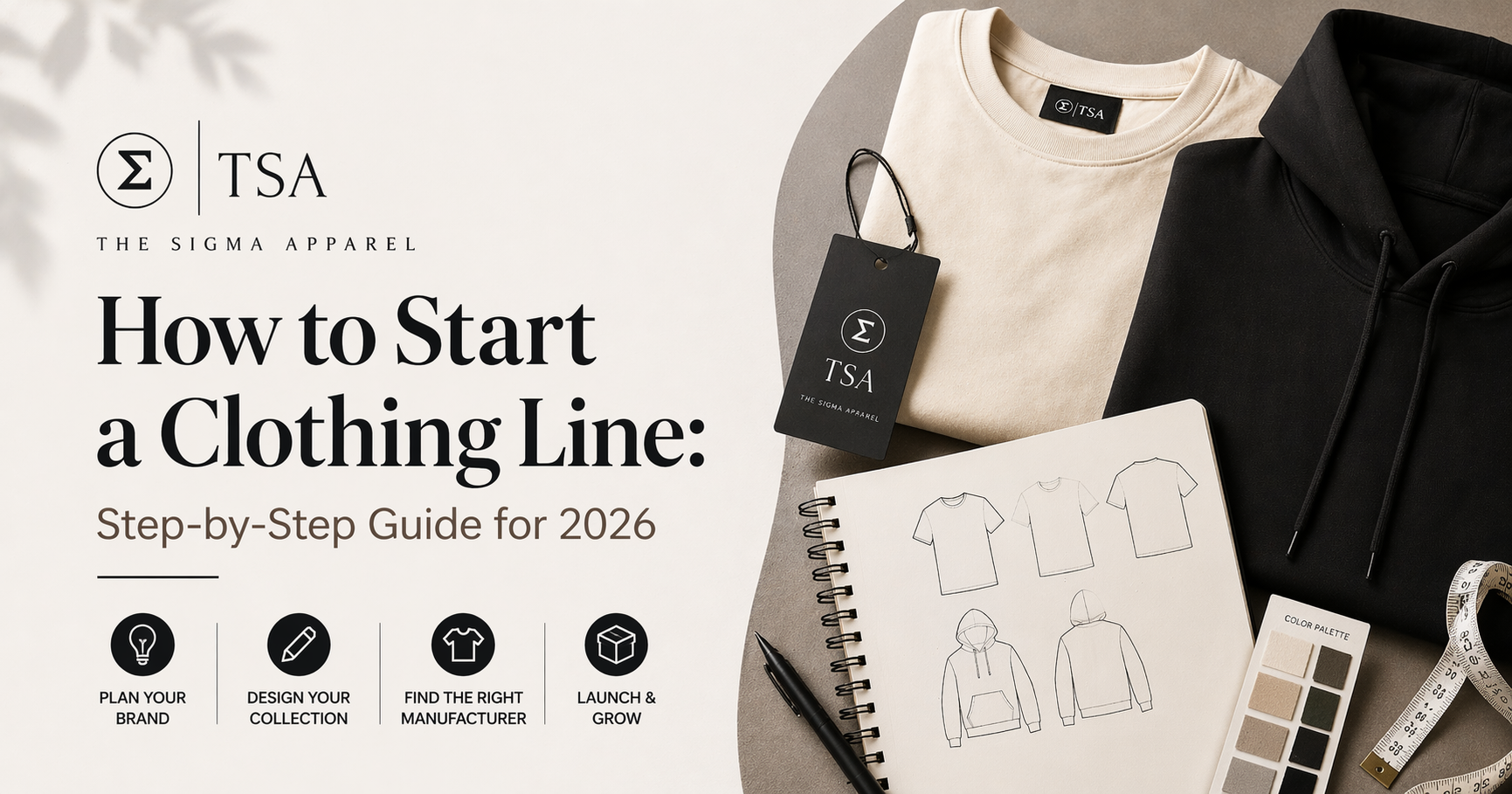
Starting a clothing line has never been more accessible — but it has also never been more competitive. The brands that succeed in 2026 are the ones that combine a clear niche, strong branding, and a reliable manufacturing partner. This guide walks you through every step.
Step 1 — Define Your Niche
The biggest mistake new clothing brand founders make is trying to appeal to everyone. The most successful brands own a specific lane — sustainable activewear for women over 40, workwear for tradespeople, oversized streetwear for Gen Z, luxury basics for minimalists.
Ask yourself: who is my exact customer, what do they currently wear, what is missing from their wardrobe, and why would they choose my brand over what already exists?
Your niche shapes everything — the garments you make, the fabrics you choose, the price point you target, and the manufacturers you work with.
Step 2 — Research Your Market
Before spending a dollar, validate your idea. Look at what competitors are doing and identify gaps. Browse Instagram, TikTok, and Pinterest to understand what your target customer is currently buying and engaging with. Check search volumes for keywords in your niche. Read Reddit communities and Facebook groups where your target customer hangs out.
The goal is to enter the market with a product that people already want — not to convince them they want something new.
Step 3 — Create Your Designs
You do not need to be a fashion designer or know how to draw to start a clothing line. What you need is a clear vision for how your garments should look and feel.
Start with sketches — even rough ones — or use reference images to communicate your idea. Tools like Canva, Adobe Illustrator, or CLO 3D can help you create more polished design files. You can also hire a freelance fashion designer on platforms like Upwork or Fiverr to bring your concepts to life.
Once your designs are in a shareable format, your manufacturer will use them to create a tech pack — a detailed technical document that specifies every measurement, material, color, and construction detail.
Step 4 — Source Your Manufacturer
This is the most important step. Your manufacturer determines your product quality, your production costs, your lead times, and ultimately your brand reputation.
When sourcing a manufacturer, look for low MOQ (100–200 pieces is ideal for starting out), full-service production including cut and sew, a clear sampling process, and strong communication.
Consider whether you need specific services like screen printing, sublimation printing, custom embroidery, or specific fabric types. Not all manufacturers offer everything under one roof — finding one that does saves enormous time.
At The Sigma Apparel, we work with clothing startups from their very first collection. Our MOQ of 100 pieces means you can test your designs without overcommitting, and our full-service process covers everything from tech pack creation and sampling through bulk production and shipping. Explore our full range of services here.
Step 5 — Get Your Tech Pack and Sample Made
Once you have chosen a manufacturer, the process starts with a tech pack — a document that tells the factory exactly how to make your garment. It includes technical drawings, measurements for every size, fabric specifications, color references, print placement, and label details.
After approving the tech pack, a physical sample is produced. This is your chance to test everything — fit, fabric quality, color accuracy, stitch quality, and overall finish. Request changes if anything is not right. Do not proceed to bulk production until the sample is exactly what you want.
Step 6 — Calculate Your Costs and Set Your Prices
Before placing your bulk order, make sure your numbers work. Your cost of goods (COG) includes the manufacturing cost per unit, shipping, import duties if applicable, and packaging.
A general rule for clothing brands is to price at 2.5x to 3x your COG for direct-to-consumer sales, and 5x to 6x COG if selling wholesale to retailers.
For example, if a hoodie costs you $18 to manufacture and ship, your retail price should be $45–$54 minimum to be sustainable.
Step 7 — Build Your Brand Identity
Your brand is more than a logo. It is the name, the visual identity, the tone of voice, the packaging, and the story behind why you started. Before you launch, make sure you have a brand name that is available as a trademark and domain, a logo and color palette, a clear brand story, and packaging that reflects your positioning.
Step 8 — Set Up Your Sales Channels
Decide where you will sell — your own website (Shopify is the most popular platform for clothing brands), Instagram Shop, Etsy for niche or handmade positioning, wholesale to boutiques, or a combination.
Set up your online store before your products arrive. Build your social media presence in the weeks before launch. Start building an email list from day one — even before you have a product, you can build an audience.
Step 9 — Place Your First Bulk Order
With your sample approved, your sales channel ready, and your finances confirmed, place your bulk order. Standard turnaround from a quality manufacturer is 30–35 business days. Use this time to finalize your website, create content for your launch, and build anticipation.
Step 10 — Launch and Gather Feedback
Your first collection will not be perfect — and that is fine. The goal of your first launch is to get real products into real customers’ hands, gather feedback, and use that to improve your next collection. Ship every order carefully. Follow up with customers. Ask for reviews. Learn from every sale.
The brands that grow are the ones that treat their first launch as a learning experience, not the finished product.
Ready to Start?
If you are ready to bring your clothing line to life, The Sigma Apparel is here to help. We work with first-time founders and scaling brands, offering custom t-shirt manufacturing, hoodie manufacturing, activewear, swimwear, kids clothing, and much more — all from a low MOQ of 100 pieces.
Get in touch today and let’s get your first collection made.