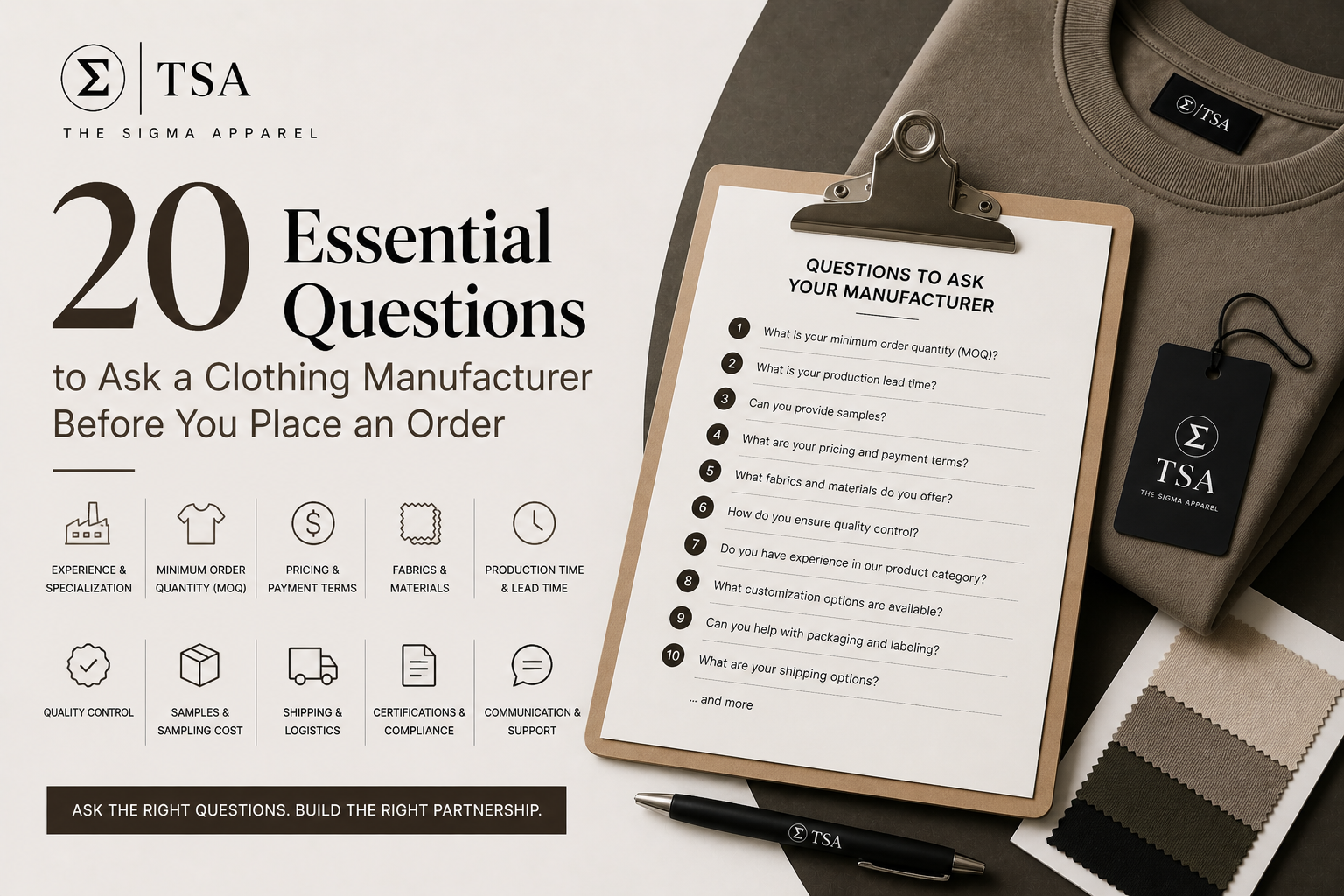
Choosing a clothing manufacturer is one of the most consequential decisions you will make as a brand founder. The wrong manufacturer can derail your launch, damage your brand’s reputation with poor quality, or trap you in a costly dispute with no leverage. The right one becomes the backbone of your business for years.
The way to tell the difference is not gut feeling — it is the quality of the questions you ask and the clarity of the answers you get. Here are 20 essential questions to ask any clothing manufacturer before committing to a production order.
Questions About Experience and Capability
1. What product categories do you specialise in?
A manufacturer that produces swimwear and a manufacturer that produces workwear have very different equipment, expertise, and quality standards. Always confirm that the manufacturer has direct, recent experience in your specific product category — not just adjacent categories.
2. Can I see your portfolio or past client work?
Ask to see physical samples or high-quality images of recent production work in your category. A manufacturer that cannot show you examples of what they have produced should be approached with caution. Sigma Apparel’s portfolio shows real production samples across all our garment categories.
3. Do you handle production in-house, or do you outsource?
Some manufacturers act as intermediaries — taking your order and outsourcing production to a third-party factory. This adds cost, reduces transparency, and makes quality control harder to manage. Always ask whether the manufacturer owns and operates their own production facility or subcontracts.
4. What is your team’s experience with my type of product?
Specific garment categories require specific expertise. Ask how many years the production team has been making garments in your category, and ask to speak with the technical or design lead if you have a complex brief.
Questions About Minimums and Pricing
5. What is your minimum order quantity — and does it apply per style or per colour?
Always clarify exactly how the MOQ is structured. 100 pieces per style is very different from 100 pieces per style per colour. If you are launching a t-shirt in 4 colours, a per-colour MOQ of 100 means you need to order 400 units minimum.
6. How does your pricing change at different volumes?
Ask for a tiered pricing breakdown — what is the cost per unit at MOQ, at 500 pieces, and at 1,000 pieces? This tells you what your unit economics look like as you scale and helps you plan your pricing strategy from the outset.
7. What is included in your quoted price?
Confirm exactly what is and is not included in the quoted price. Does it include sampling? Tech pack creation? Custom labels? Packaging? Shipping? Unexpected add-ons at invoicing stage are a common source of friction with new manufacturing partnerships.
Questions About Quality and Process
8. What does your sampling process look like?
A reliable manufacturer will always produce a physical sample before committing to bulk production, and will revise the sample until it meets your approved tech pack specifications. If a manufacturer pushes you to skip sampling to save time or cost, that is a red flag.
9. How do you handle quality control?
Ask specifically how QC is conducted — at what stages of production, by whom, and against what standard. The answer should be specific: dedicated QC team, inspection against tech pack measurements, AQL sampling of finished units before shipment.
10. What happens if the bulk production does not match the approved sample?
This is a critical question that many brand founders forget to ask before ordering. Get the answer in writing as part of your contract. A manufacturer that refuses to take responsibility for deviations from the approved sample is not a safe partner.
11. What is your defect rate, and how do you handle defective units?
Ask for their typical defect rate and what their policy is for defective garments that slip through QC. Reputable manufacturers will offer replacement or credit for confirmed defective units.
Questions About Timeline and Communication
12. What is your standard lead time from order to delivery?
Get a specific timeline in business days, not weeks, and clarify whether this starts from order placement or from sample approval. Build additional buffer time into your planning — production delays are common even with the most reliable manufacturers.
13. Who will be my point of contact throughout the production process?
You should have a named account manager or project lead who you can contact directly throughout your order. Avoid manufacturers where communication goes through a generic inbox with no named contact.
14. How do you communicate production updates?
Ask about the cadence and method of production updates. Regular communication throughout the production run is a sign of a professional, transparent operation. Weekly updates with production photos at key stages is a reasonable expectation.
Questions About Compliance and Confidentiality
15. Will you sign an NDA to protect my designs?
Your design files are your intellectual property. Always request an NDA before sharing design files, tech packs, or brand assets with any manufacturer. A professional manufacturer will sign without hesitation.
16. Do you work with my competitors?
You may not get an honest answer to this, but it is worth asking. More importantly, confirm that your designs will be kept confidential and that the manufacturer will not produce your garments for any other client.
Questions About Logistics and Payment
17. What payment terms do you offer?
Industry standard is a 30–50% deposit at order confirmation and the balance on or before shipment. Be wary of manufacturers requiring 100% payment upfront — this removes your leverage if there are quality issues. Sigma Apparel offers flexible payment options including credit card, bank transfer, PayPal, and Zelle. Contact us to discuss payment terms for your order.
18. What shipping options and Incoterms do you offer?
Confirm whether the manufacturer ships on DDP (Delivered Duty Paid — they handle all duties and customs), FOB (Free On Board — you take responsibility from the port of origin), or another arrangement. For new brands without import experience, DDP is usually the simpler option.
19. Do you have experience shipping to my country?
A manufacturer that regularly ships to the USA, UK, Canada, or Australia will have established logistics relationships and customs experience that reduces the risk of delays and unexpected import costs.
20. Can I visit your production facility?
A manufacturer that welcomes facility visits — whether in person or via a live video call — is demonstrating transparency and confidence in their operation. Virtual factory tours have become standard practice in the post-pandemic manufacturing industry and are a reasonable request for any large order.
Frequently Asked Questions
How do I verify a clothing manufacturer is legitimate?
Request a physical sample from their existing range, ask for references from current clients, verify their business registration, and request a virtual or in-person factory tour. Legitimate manufacturers are transparent about their operation and welcome scrutiny.
Should I sign a contract with my clothing manufacturer?
Yes. A written agreement covering MOQ, price, timeline, quality standards, sample approval process, defect policy, payment terms, and confidentiality is essential. Never proceed to bulk production based on verbal agreement alone.
What is a red flag when choosing a clothing manufacturer?
Key red flags include: no physical sample before bulk production, refusal to sign an NDA, vague or evasive answers to direct questions, no named point of contact, pressure to pay 100% upfront, and inability to show a portfolio of recent production work.
How many manufacturers should I contact before choosing one?
Contact at least 3 to 5 manufacturers before making a decision. Compare their responses to your questions, their quoted pricing and MOQs, and the quality of their sample work. The initial communication style is often an accurate predictor of how well they will communicate throughout a production run.